Artigo da Oeste International Community Volunteers
In the northern hemisphere, the hundred days stretching from the first of December to early March are the darkest and coldest of the year. The winter solstice, with its promise of longer days ahead, marks an important moment of communion with our Sun. Echoing the Yuletide of pre-Christian times, our festivities between Christmas and New Year’s reflect our joy at this great annual pivot. But the darkest, coldest days are only one-third over by the time the last Réveillon hangovers have faded. In pre-modern Northern and Central Europe, the months without crops and dwindling reserves ground down the spirit and opened the door to madness. It was widely held that evil winter spirits had to be driven out so that fertility could return to Earth. Given fertility’s association to the 28-day cycles of the moon and the menses, the Ancients often practiced these rituals on pivotal nights in the lunar calendar.
The Celts who settled western Iberia two-and-a-half millennia ago burned large puppets representing these maleficent forces. This folk practice was folded into Portuguese variants of the Christian mid-winter feast in the 13th Century. In some Portuguese towns, in the weeks leading up to Carnaval, effigies of the opposing forces are still thrown into the flames, but this time as part of a ritualized reenactment of the battle of the sexes known as the nights of the Comadres and the Compadres, a series of pranks and displays meant to reinforce loyalty to one’s own gender.
With the Visigoth kings in the 5th century, a fervent brand of Christianity came to the peninsula. In a solemn reminder of Jesus’ 40 days in the desert, the Church set aside the 40 days before Easter for the Sacrifice of Lent. These weeks of fasting and spiritual cleansing conveniently coincided with the time of year when supplies were at their lowest. Since Easter is defined as the first Sunday after the first full Moon following the spring equinox, this apex celebration of the Christian calendar also indirectly ties Carnaval back to the old lunar rites.
In the Middle Ages, the gentry would prepare for Lent by distributing the last remnants of preserved meat and animal fat to the peasants working their lands. The last day before the fast therefore became known as Fat Tuesday. The most plausible origin of the word Carnaval is the Latin word for meat, as in the Late Latin phrase “Carne Vale!”, or “Farewell, Meat!” In the 16th century, groups of roving young men started to take the days before Lent as an excuse to drink excessively and pull outrageous pranks.
Contemporary Carnaval culture in Portugal owes a lot to its largest, most multiracial former colony, Brazil. Under Italian influence, by the 1830s, Brazilians had created the modern parade structure and the costumed street party. In the late 1800s, Brazilian Carnaval revelers were already marching to the Afro-Caribbean beats which still provide the backdrop of Portuguese Carnaval today in the form of samba and axé music.
Aspiring to appropriate the trappings of ancient Roman glory, the Salazarist dictatorship sought to emphasize a martial tone in Carnaval proceedings with marching bands and majorettes. However, in the streets, Carnaval remained one of the few avenues for social critique and political satire, echoing the Roman concept of Saturnalia, a time of year when hierarchies were overturned and outrageousness reigned.
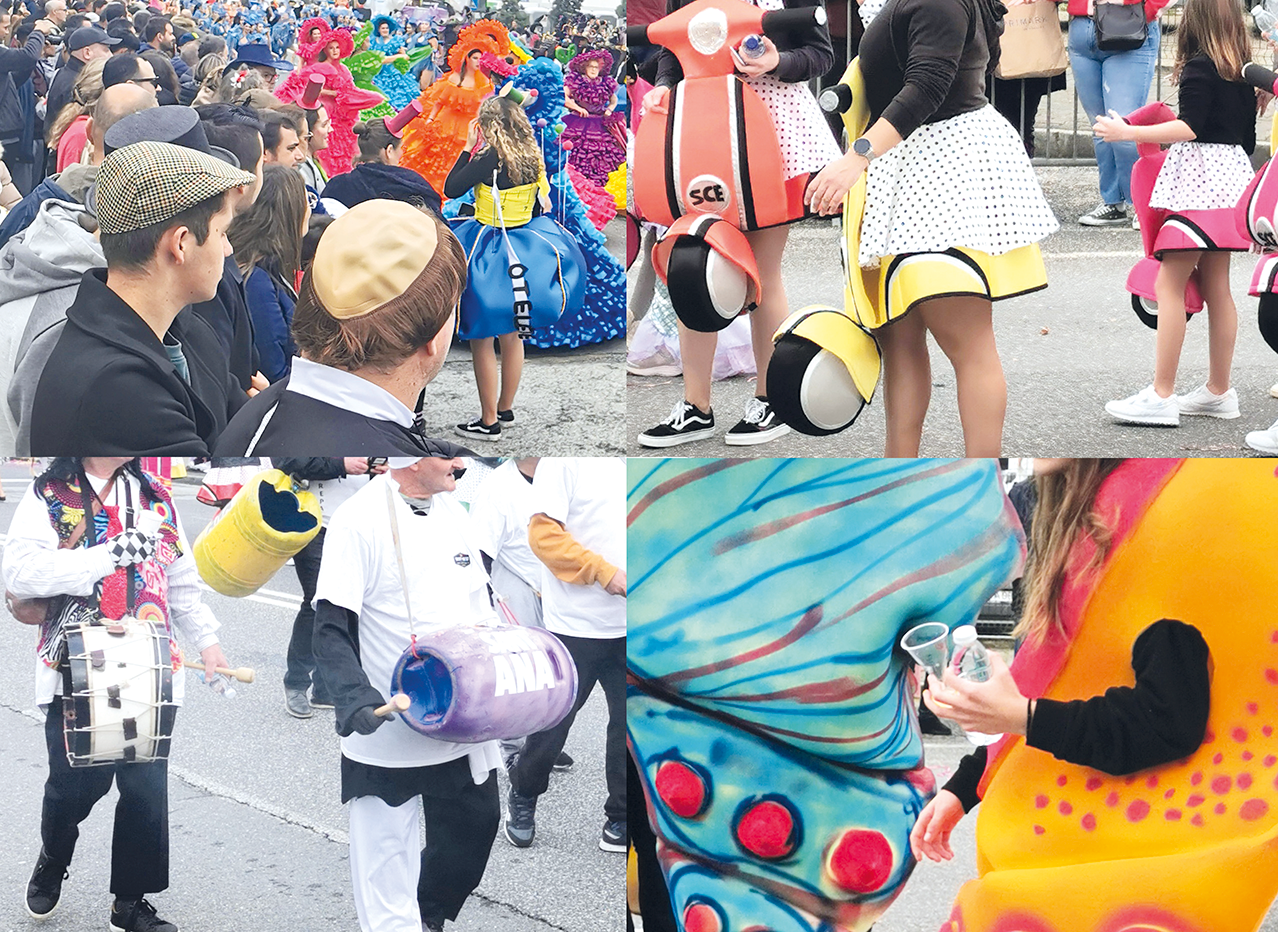
Torres Vedras is known as the Carnaval city par excellence. The cortege of allegorical floats, outrageous Matrafonas (men in drag), and Cabeçudos (giant heads) represent the quintessence of the modern Portuguese Carnaval. It was not until the 1920s that the pre-Lenten festivities evolved from bals and recitals organized by local clubs into a unified street fair sponsored by the city’s leading commercial interests. In the 1930s, the municipality made a concerted effort to promote its Carnaval at the national level. Since then, hundreds of thousands of people have been converging in Torres to join the party on the four days before Lent. You can dance in the cortege if you buy a wristband (€8 for one day, €16 for all four).
Caldas da Rainha’s celebrations exemplify the “for us, by us” spirit of the typical small-town Carnaval. Neighborhood groups and associations will dust off their themed or satirical costumes and march in three parades down Avenida 1° de Maio on March 1st (21:00), 2nd and 3rd (both 15:00). Bals will be held at the Céu de Vidro in Parque D. Carlos I on March 1st and 3rd (23:00-4:00). Proceeds from the modest entrance fee will be donated to charity.
Would you be interested in contributing stories to the OICV page in Gazeta das Caldas? We are looking for writers! If you would like to participate, please contact us at OICV.email@gmail.com. ■
